Saturday, 6 October 2012

#182 David Copperfield (1850)

Author: Charles Dickens
Title: David Copperfield
Genre: Novel
Year: 1850
Pages: 980
Origin: read on the Kindle during August-September 2012
Nod Rating: 4 nods out of 5


‘Of all my books, I like this the best. It will be easily believed that I am a fond parent to every child of my fancy, and that no one can ever love that family as dearly as I love them. But, like many fond parents, I have in my heart of hearts a favourite child. And his name is David Copperfield.’
(Charles Dickens, 1869)
Such is the beatification of David Copperfield: Charles Dickens has blessed it as his favourite, whilst other writers – of the high ilk of Tolstoy, Dostoyevsky and Woolf – appear to be in unison on the greatness of the novel. Woolf, in particular, was read the book on several occasions, assessing it ‘magnificent’. These are massive endorsements, especially when considering the bulk and expanse of Dickens’ canon of fictional creations.

David Copperfield (or, to give its wondrously large original title: The Personal History, Adventures, Experience and Observation of David Copperfield the Younger of Blunderstone Rookery (Which He Never Meant to Publish on Any Account)’) was initially published in serial form across two years – similarly to many other Dickens novels. It follows the life of its title character, from childhood to manhood, in what is hailed an example of a bildungsroman novel.

For the Worm, this was to be the second attempt at reading the novel whole. The first began many moons ago, having bought a cheap copy in a second hand book shop and spending days not going to class but rather read dusty volumes in a nearby park. Pretentious? Yes. And far too long for the attention span of a sixteen year-old. The moons have continued to pass, and now it was time to return to the novel, to continue beyond page two-hundred and finally attain closure on this story. Of course, the old dusty volume is no longer with us and is long gone; in its place is the robust and ever-ready (dependent on battery life) Kindle, that now homes many of Dickens’ famous novel. David Copperfield is one of the first in a journey through the mind of one of the world’s greatest writers.

Although the storyline is not – arguably - as well known as the other novels in Dickens’ catalogue (principally those of Oliver and Great Expectations), the colourful character descriptions find the author on the top of his game. Here are a few examples, including that of his nurse Peggotty, with ‘eyes so dark that they seemed to darken their whole neighbourhood in her face, and cheeks and arms so hard and red that I wondered the birds didn’t peck her in preference to apples’; the ominous arrival of the Murdstone’s: ‘the gloomy taint that was in the Murdstone blood, darkened the Murdstone religion, which was austere and wrathful’; the hilarious and bumbling Mr Micawber ‘who was a thoroughly good-natured man, and as active a creature about everything but his own affairs as ever existed, and never so happy when he was busy about something that could never be of any profit to him’; the villainous Uriah Heep: ‘All this time he was squeezing my hand with his damp fishy fingers, while I made every effort I decently could to get it away’; and the rather more cheerful names for his wife, Dora: ‘Child-wife’ and ‘Little Blossom’.

Furthermore, the description of thoughts, feelings and surroundings find a writer who has improved from earlier “fancies”; a writer who is stepping into a second, in-depth and all the more creative period of his life. The Worm delighted in reading the young Copperfield’s earliest memories of his dead father:

‘the remembrance that I have my first childish associations with his white grave-stone in the churchyard, and of the indefinable compassion I used to feel for it lying out alone there in the dark night, when our little parlour was warm and bright with fire and candle, and the doors of our house were – almost cruelly, it seemed to me sometimes – bolted and locked against it’.
And the recalling of his wedding day to his ‘Child-wife’:

‘Of her waving her little hand, and our going away once more. Of her once more stopping, and looking back, and hurrying to Agnes, and giving Agnes, above all the others, her last kisses and farewells. We drive away together, and I awake from the dream. I believe it at last. It is my dear, dear, little wife beside me, whom I love so well! “Are you happy now, you foolish boy?” says Dora, “and sure you don’t repent?” I have stood aside to see the phantoms of those days go by me. They are gone, and I resume the journey of my story.’

The novel – the plots and subplots of which are far too vast to fully cover in this review – enrapture characters of the good (Traddles, Peggotty and her brother, Mr Peggotty, as well as Dr Strong), the bad (Uriah Heep and the Murdstones), the confused (the Micawbers), the mistreated (Mr Mell), the complex (Rosa Dartle) and the bold (Betsey Trotwood and James Steerforth); and unfortunately, the dull (chiefly, the angelic and dutiful Agnes). As in every Dickens novel, we have the battle between good and evil, the peculiar and comedic elements that surround us, as well as that classic Dickensian theme: the differences between class in Victorian society.

The Worm’s three largest gripes with this novel are the following: the first, is the weakness of Copperfield as a character. The book is filled with colourful people, memorably the likes of Steerforth, his aunt Betsey Trotwood and Peggotty. However, Copperfield himself appears devoid of doing evil or harm (bar, perhaps, the incident with Dora’s father); he is left to play the straight-man to the incidents of others around him, something of a blank canvas to be impressed upon. The book’s first quarter – that of Copperfield’s youth – hints upon the boy having been an unreliable narrator; an element not followed up by Dickens. The Worm’s evidence for this is, admittedly scant, and may have been an invention of his mind in the hope of a greater pay-off as Copperfield entered manhood. But there are a few remarks, including: ‘When my thoughts go back, now, to that slow agony of my youth, I wonder how much of the histories I invented for such people hangs like a mist of fancy over well-remembered facts!’

The second gripe focuses on the supposed villainy of Heep. Undoubtedly, Heep plays the part of the “bad guy” in illicitly stealing the funds of those around him; but he has a long way to go to repeat the wickedness and complexity of other Victorian creations, principally that of Bronte’s Heathcliff. Furthermore, Copperfield’s instant dislike to this character is at odds with his transaction with every other person in this novel: after all, instant affection and warmth is one of Copperfield’s few saving graces.

But the gripe that eclipses all others is the rambling structure of the plot. This is a common complaint held against Dickens, who didn’t write succinct novels, but rather a series of chapters to be published week after week. This feature has a modern equivalent in the never-ending soap operas on television; or more exactly in the Worm’s reading material, that of an extended comic book run, with prints issued each month. It is clear that Dickens introduces characters, such as the legendary Micawber, to await a pay-off further down the road; what is not clear is the author’s actual intention in the finish line when commencing this story. It is this sense of chaos, of continuing to write until the story had worn thin, that demotes David Copperfield from the possible starry heights of a 5 nodder commendation.

But, dear reader, these gripes cannot wholly detract from what is a fantastic novel. Dickens’ love is clearly shown on these pages, and as becomes clear during Copperfield’s journey, the two – author and character – are undisputedly linked. As noted above, David Copperfield was Dickens’ ‘favourite child’; the Worm, however, will continue to plough through his back catalogue, to continue forwards to the exploits of Pip, of the deeds of Darnay and Carton from A Tale of Two Cities, as well as the adventures of Nicholas Nickleby.


Buy it here:
http://www.amazon.co.uk/Copperfield-Vintage-Classics-Charles-Dickens/dp/0099511460/ref=sr_1_1?s=books&ie=UTF8&qid=1349517253&sr=1-1

Read it here:
http://www.gutenberg.org/ebooks/766

Sunday, 30 September 2012

#181 The Spanish Civil War (1965)

Author: Hughes Thomas
Title: The Spanish Civil War (1965)
Genre: History
Pages: 1,000
Origin: Bought in a second-hand bookshop in St Ives, Cornwall
Nod Rating: 4 out of 5


The Spanish Civil War is one that has long held fascination, as well as mystery, for decades of history and political readers. The befuddlement has come in the positioning of the war: a Second World War in miniature (as the author speculates), or one of unique internal friction special only to the Iberian peninsula. In truth, it is both.

Fought between 1936-1939, this confusion can be explained in the diverse political, religious, and nationalist groups taking part. These include the politicians and supporters of the republic, socialists, communists, anarchists loosely uniting to defeat reactionary, conservative forces including the bulk of the army, monarchists, Carlists, and fascists (Falangists). Each of these sides was not solidified in its support and union, with each grouping fearing the other, eager to make more gains, eager to destroy anyone against their own brand of ideology. Each side had a brutal atmosphere of infighting, whilst each smaller grouping had its own bickering and discord.

This inferno was further enraged with the introduction of the other superpowers (including fascist Italy, Nazi Germany, Soviet Russia, and an ill and failing republican France). This complex situation reaches the realms of bafflement for non-Spanish readers with the understanding of the regional differences, including Basque and Catalan nationalism. The mistrust and intrigue of two hundred years of Spanish decline ignite in these years, leading to one particular winner (Franco) and the promotion of an arch-conservative and Catholic Spain that endured until the fourth-quarter of the twentieth century.

Could such a history – one that gives due attention to each of these groups and situations - be satisfactorily written? The Worm himself has attempted a read of a previous book on this war, but admitted defeat once confusion set in and the words on the page appeared as strange as random numbers and exclamation points. No small book could hope to avoid such defeat; and the author of this volume – Hugh Thomas – spreads the action and analysis across one thousand pages. Much attention is devoted to the run-up to the war, including the years of the doomed second republic of the 1930s, as well as concentrating on running threads – religion, politics, society – from the past two centuries. The book is split into three sections: the rising and revolution, the fighting of the war, followed by the defeat of the republic and victory for Franco. The typical exchange of one side against the other is narrated; as well as the internal intricacies of this war: including the hopes of the revolutionaries within Spain (anarchists, communists, socialists, and falangists), and the charting of their decline and extinction.

As can be expected from such a mammoth task, there are a few bugbears throughout these pages. One is the imbalance of attention devoted to the first year of the war; in comparison, the second half of the war is visited in fly-by motion. Is this a reflection of the war itself, or rather the author’s own power to attention failing as the light of the end is sighted? More annoyingly is the attention given to the nations of the world, principally the main European powers as well as the USA. Of course, this war had numerous connections to foreign aid (that of Italy and Germany on the side of Francoist Spain, and the USSR on the side of republican Spain); however, this does not account for the willingness of Thomas to return to the apparent safety confines of Westminster and the endless commentary on the communications of ministers of Parliament. The agreements and non-agreements of the Non-Intervention Committee takes on a larger role than is needed within this history, and is evidence of a typical Anglo-bias from a British historian.

Yet for an attempt of making sense of a particularly wild piece of history, Thomas’ The Spanish Civil War succeeds in many ways where other lesser historians have failed. Since its first publication in the 1960s – at a time when the wounds of the war remained sore – it has survived in print and reprint throughout the past fifty years. The Worm thoroughly enjoyed the plots, the battles, the characters, and the fight that each participant – no matter how divergent their beliefs and ideals – believed was right. Such a significant war deserves a writer fitting to analyse and narrate; luckily, Thomas was, and continues to be, the man for this job.


Buy it here:
http://www.amazon.co.uk/The-Spanish-Civil-Hugh-Thomas/dp/0141011610 

Friday, 21 September 2012

#180 Superman & Batman Versus Aliens & Predator (2007)

Authors: Mark Schultz (writer) & Ariel Olivetti (artist)
Title: Superman & Batman Versus Aliens & Predator
Genre: Graphic Novel
Pages: 110 pages
Origin: read on during August 2012
Nod Rating: 2 nods out of 5


Only comics can bring about such bizarre and incongruous titles. When first flicking through a catalogue of graphic novels, the Worm was immediately caught to this particular one. A self-proclaimed Batman fan (as will be seen in a few weeks time with a forthcoming book review related to the Dark Knight), the addition of other characters only offers two possible conclusions: the most fantastic comic book ever created, or another failure based on trying to cash in on various markets. Let’s be straight: this is not the most fantastic comic ever created. But for a comic printed to make a quick buck, it is not all so bad. And allow the Worm to explain why.

Originally a two part comic series released in 2007, the story is set in the Andes and finds Clark Kent (and the ever, unfortunately, inseparable Lois Lane) on location for a report. Soon enough Kent is transformed into Superman and is buddied up with Batman, who are attempting to solve a riddle of dead bodies and “unusual activity” near a volcano. This “unusual activity” is soon found to be a group of Predators and various Aliens who have been stranded on the Earth for many years, ever since crash landing at some point during the last ice age. Our two heroes squabble over how to deal with this threat: Superman wants to save them before the nations of the world unite to nuke the area; whilst Batman believes annihilation is only way to safeguard the planet.

Such a plot outline might possess enough power to send many of you to sleep. But there is enough action within the series to keep the reader on their toes, including Batman grappling with a group of Predators who wish to cook him, and a weakened Superman (as per usual) going fisticuffs with an Alien. The very cheek and confusion of putting these characters together is enough to sustain interest. However, the element that keeps this particular book from falling into the pit of the 1 nodder damned is the art-work. Beautifully drawn, it is in bold contrast to the actual storyline. Olivetti shows a great talent, and one that would be better served beyond the confines of this cash-in idea.

This particular mini-series follows in a line of other titles (including Aliens versus Predator, Batman vs. Predator, Superman vs. Aliens, and pretty much any other superhero you can imagination coming up against bizarre aliens created in 1980s action movies starring the likes of Arnold Schwarzenegger). It would be naïve to think that comic book publishers would stop printing such weak titles; however, with some tweaking of the storyline and the continuing employment of such artists, perhaps the worst abuses of these titles can be eradicated.


Buy it here:
http://www.amazon.co.uk/Superman-Batman-Aliens-Predator-Graphic/dp/1401213286/ref=sr_1_1?ie=UTF8&qid=1347721335&sr=8-1

Monday, 17 September 2012

Plymouth's Very Own Book Festival


Plymouth – the Worm’s hometown – has long been known for its naval dockyard and love of concrete cancerous buildings. But this week its cultural status has gone up a rank or two with the celebration of its very first International Book Festival.

The Festival kicked off over the weekend and will run until 23rd September. It promises to bring ‘the very best writers, poets, illustrators, musicians and spoken word performers from the UK and around the world’ to this city. A click on the link will confirm whether such a statement is fact, or perhaps fiction (depending on your own opinion and reading standards).

Whatever the verdict, such an event is a welcome arrival to Plymouth; if it is here to stay, the city can only thrive. The Worm urges all Plymothians to take advantage of this somewhat aberration on the normal “cultural” calendar.


Find out more here:
http://www.plymouth.ac.uk/pages/view.asp?page=38529

Saturday, 15 September 2012

#179: My Ancestor Was An Agricultural Labourer


Author: Ian H Waller
Title: My Ancestor Was An Agricultural Labourer
Genre: Genealogy
Pages: 130
Origin: Purchased from Amazon during August 2012
Nod Rating: 2 nods out of 5


Family tree enthusiasts proudly boast of genealogy’s popularity on the internet, second only to that much supported viewing habit: pornography. Recent years have seen a massive boost to this past-time, of which many factors – improved resources on the internet, as well as popularity of programmes such as Who Do You Think You Are? – have seen a true renaissance in genealogical studies.

The Worm himself is currently in the midst of researching his family tree, and can attest to its addictive nature. Hence the purchase of this particular book, the rather mundanely named My Ancestor Was An Agricultural Labourer. Yes, we’d all like to trace our connection to royalty or people of importance in history; but as the book’s author, Ian H Waller, points out, nearly all of us have links to the English countryside in one form or another.

It is more than a simple guide to tracing sources; Waller takes a historical approach in the hope of generating more interest and educating the reader on conditions in the past. Most focus is on the Victorian period, including events such as the Swing Riots, the formation of agricultural trade unions, and the later agricultural depression. Of more interest is the description of the day in a life of an agricultural labourer, all of which thoroughly shamed the Worm in the contrasted decadent luxury of his own life (and shame you must feel, also, fellow readers!).

As a person who has studied and lectured on this topic, it is safe to say that Waller never runs out of something to add on this particular profession. In great and un-exhausting detail, he sets out possible routes of research: from basic records and newspapers to apprenticeship records and vaccination records. Such a breadth of activity suggests more than an interest – perhaps a love – with this area of study. However, Waller himself fails to bring much of these events alive for the reader. And as such, the book remains a read best served for those die hard family tree enthusiasts; a book needed to complete a section of research, rather than to be enjoyed on its own merits.

Buy it here:
http://www.amazon.co.uk/Ancestor-Was-Agricultural-Labourer-was/dp/1903462983

Tuesday, 11 September 2012

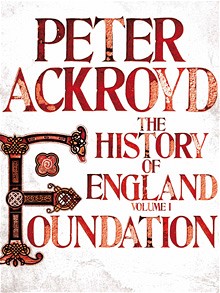
#178: The History of England. Volume I: Foundation (2011)

Author: Peter Ackroyd
Title: The History of England Volume I: Foundation
Genre: History
Pages: 450
Origin: bought from The Works for the bargain sum of £3.99
Nod Rating: 3 out of 5


A historian may be talented and have researched many nooks and crannies of the past that have delighted readers, but without that large focus on the broad reach of a nation’s history – the quest of the magnum opus – they seem to remain a figure not cut of heavyweight cloth. Peter Ackroyd has established a name for himself as one of London’s chief story-tellers – in both fiction and non-fiction – as well as publishing a list of books long and varied. Areas have been dealt with ranging from journalism to Edgar Allen Poe, from Oscar Wilde to Venice. But what of this work, his apparent ambition of the much desired and elusive opus?

The big theme has been concentrated on: a whole history of one particular nation and people. It follows in the footsteps of other popular historians, most notably that of Simon Schama and his three volumed work on Britain. But rather than deal with the whole of Britannia, in this devolved and politically fragmented times Ackroyd unashamedly deals with the largest nation of these isles: England.

The book begins in a land not so far away some 900,000 years ago, ending with the death of Henry VII in 1509. A large scan of history, even for a book of some five-hundred pages. For those readers who are accustomed to a “biography” of a nation, the start of such a book in the midst of time is no real surprise. The nation may change, but the pattern is usually the same: pre-history and the stone age, followed by the coming of the Romans, the vacating of the Romans, the feuding tribes of the Dark Stages, and then viola, we have the arrival of William the Conqueror. All of this is dealt with within 70 or so pages, leaving the bulk of this book to deal with the Norman and subsequent Plantagenet kings. Of histories on England, normal service is resumed: that is to say, a political narrative history based on the kings of England and their dealings with their back-stabbing off spring and their feuds with other kings of France.

This is undoubtedly a shame, and a routine that Ackroyd appears conscious of due to his parachuting of small chapters discussing life in a certain decade or century. These small chapters – some no more than two pages – appear to dig up some interesting local sources and stories. It is unfortunate that Ackroyd was unable to make more of these chapters, thereby side-stepping the usual political procession. Other disappointed points include the lack of proper time committed to the land of pre-1066, whilst the insistence of naming those in pre-history as “English” is annoying (especially given that there is no preface to explain the reasoning for this). Obviously such nitpicking – a forte of the Worm’s – detracts from what is a readable book, albeit one that lacks in full force of imagination.

Volume I completed, there is more to come. However, the Worm will be blunt to the point: if the usual story is written and printed, the future volumes will be avoided. There is enough already weighing down good bookshelves containing this plotline. Magnus opus, it is not. The quest, then, must go on.

Buy it here:http://www.amazon.co.uk/gp/product/0230706398/ref=pd_lpo_k2_dp_sr_1?pf_rd_p=103612307&pf_rd_s=lpo-top-stripe&pf_rd_t=201&pf_rd_i=0230706401&pf_rd_m=A3P5ROKL5A1OLE&pf_rd_r=04W7ADTWF2VA7T1DVE8H

Monday, 27 August 2012

#177 V For Vendetta (1990)

Authors: Alan Moore & David Lloyd
Title: V For Vendetta
Genre: Graphic Novel
Pages: 300
Origin: borrowed from Plymouth University library and read during July-August 2012
Nod Rating: 4 out of 5


The Worm confesses to developing an infatuation with Alan Moore in recent months. As can be seen in recent reviews, a massive 5 nods was given to his Watchmen graphic novel, whilst a further 3 nods was laid out for his short book on the art of writing for comics. Is this a sign that the Worm is becoming far too generous in his older age? The Worm stresses that these nods are for a fantastic writer who is always on the hunt of widening our imaginations in his story telling.

As such, the Worm thought it best to return to the near beginnings of Moore’s career: V for Vendetta. It is a dystopian story set in the near future, in the world of the late 1990s in which nuclear bombs have been set off, and power in Britain has been taken over by a fascist religious political party. Hidden behind a mask, and dressed in the sartorial style of Guy Fawkes, V is on a one-man quest to bring down the government and show everyone the existence of their chains; and more importantly, the power to break those chains to reclaim their liberty.

The story principally follows V in his underworld alongside his new sidekick, the naïve and uninitiated Evey; as well as the groups who pursue him with their own motivations and reasons. V is at odds with everyone in this nightmarish vision of the future: his love of poetry and good music is a rebellion against the dark skyline, drab coasts and kitchen-sink dramas played out in the city of London. V’s seemingly riddled and flowery prose may be slightly annoying at first, but as each page is turned they are increasingly seen as the light to behold against the dark forces that have taken control of old Blighty. In typical Moore fashion, the “good guys” and the “bad guys” are never clear cut: is V a hero or simply a psychotic murderer? It is up to the readership to decide. Alongside this ambiguity lies stylish and always interesting framing of the page; seen nowhere more clearly than at the beginning of Book Two: The Vicious Cabaret in which sheet music is displayed when connecting all of the various plot strands.

However, V for Vendetta is not an entirely accessible read. Beside the nature of the subject, many of which could find off-putting (in essence, an anarchist terrorist killing fascists), there is the actual storyline itself. There is a heady mix of convoluted plot and an array of characters – many of which are hard to distinguish from one another – which means that this is not a book to merely flipped through in a day. The Worm had the pleasure to read the story over the period of several weeks, continually dipping back towards the beginning, and thumbing through pages to link the various plots. It must be advised that other readers should take the same luxury of an amble walk, rather than power read.

In this handsome edition (containing the full comic strips, prefaces from both writer and artist, as well as extended essay on the genesis of V for Vendetta), Moore discusses just how badly his own predications shown to be: no, Thatcher was not removed from office in the 1983 election, and no, a socialist type government did not take control. Of course, the Falklands factor put paid to Thatcher’s ousting in ’83; but the story is not one based on concrete fact, but rather of ideas. These ideas – of freedom and liberty – remain imbedded within us; as are the threats that these ideas and beliefs face from forces all around us. In the character of V, Moore and Lloyd have created an eternal character that is used to rally the forces of liberty against her would-be destroyers: within the comic’s conclusion, as well as in real life. Such real life similarities can be seen in the choice of the group Anonymous and their V masks as a potent symbol.

Avoid the dull, tame movie from 2006 and instead go full flying into the original comic. It may not be to your political taste, but it will surely inflame and excite the bones in your body.


Buy it here:
http://www.amazon.co.uk/V-Vendetta-Edition-Alan-Moore/dp/1845762274/ref=sr_1_1?ie=UTF8&qid=1346093967&sr=8-1

Read the review for Watchmen right here:
http://4eyedbookworm.blogspot.com/2011/11/watchmen-alan-moore-dave-gibbons.html 

Thursday, 23 August 2012

#176 The Sign of the Four (1890) - Arthur Conan Doyle

Author: Arthur Conan Doyle
Title: The Sign of the Four (1890)
Genre: Novel
Pages: 160
Origin: Read on Kindle during July 2012
Nod Rating: 3 out of 5


'Which is it to-day?... morphine or cocaine?’

And so begins this story about the adventures of Sherlock Holmes and the book’s narrator, Watson. Dulled by a lack of events, Holmes has taken to a bit of recreational drug-use of the kind that would scare those in authority in today. Only the sniff of a good case and putting his deductive reasoning skills to the test will allow him to "just say no" to 'a second dose of cocaine’.

This is the Worm’s second foray into the world of Sherlock Holmes; more than one year ago the first instalment in the series – A Study in Scarlet – was reviewed and given scant applause (see below). The novel itself, as written by Watson, is alluded to in the beginning of The Sign of the Four by a critical Holmes: ‘Honestly, I cannot congratulate you upon it. Detection is, or ought to be, an exact science, and should be treated in the same cold and unemotional manner. You have attempted to tinge it with romanticism, which produces the same effect as if you worked a love-story or an elopement into the fifth proposition of Euclid.’

Watson retorts: ‘But the romance was there.’ Of course, this clearly shows the divide between Holmes and Watson; a conflict that has endured and delighted readers for more than a century. Much more than the recent movies or other incarnations of the pair, the original books offer so much more character development; as can be seen by Watson’s constant observation and analysis of Holmes: ‘More than once during the years that I had lived with him in Baker Street I had observed that a small vanity underlay my companion’s quiet and didactic manner.’ More strongly, is Watson’s later cry out: ‘You really are an automaton… There is something positively inhuman in you at times.’

The Sign of the Four - also popularly known as The Sign of Four - is the second novel to feature this dynamic duo. It charts the unfolding of a missing fortune, of double-crossing and revenge between an original foursome from the subcontinent of India. Holmes continues to spout his own philsopophy and way of working: ‘Eliminate all other factors, and the one which remains must be the truth.’ Whilst Watson continues to inject the romance into the story, continually questioning his own role, Holmes’ methods, the love-interest (Mrs Morstan), and how the whole story hangs together. In wonderful fashion, all of the threads come crashing together with a final confession and extended flashback from the chief culprit (thankfully, the flashback does not consume more than a third of the book, as was the case with A Study in Scarlet).

Without wishing to spoil any of the main plot threads, the adventure ends as it begins, with Holmes reaching for the ‘cocaine-bottle.’ The novel is a more coherent whole than the earlier A Study in Scarlet; whilst a greater emphasis is added on the stereotypical Sherlock settings. Late Victorian London is detailed in fine Gothic style: ‘The whole place, with its scattered dirt-heaps and ill-grown shrubs, had a blighted, ill-omened look which harmonized with the black tragedy which hung over it.’ Two novels in, and already the legend is being formed; a legend that exists more than one hundred and twenty years later.

The Worm will return to the adventures of Holmes and Watson, and is intent on devouring all the books and short stories in Conon Doyle’s inventive and wonderful series.

Buy it here:
http://www.amazon.co.uk/Sign-Four-Arthur-Conan-Doyle/dp/0241952964/ref=sr_1_1?ie=UTF8&qid=1345745407&sr=8-1

A Study in Scarlet review:
http://4eyedbookworm.blogspot.co.uk/2011/07/study-in-scarlet-sir-arthur-conan-doyle.html

Tuesday, 14 August 2012

The Top Ten Toughest Reads


This past week The Guardian printed a small article on the supposed ten most difficult reads. This list has been compiled by two book worms at the literary website, the Millions: Emily Colette Wilkinson and Garth Risk Hallberg. Admittedly a top ten would be difficult to nail down, however, the duo apparently took three years to reach the final selection. And here the tough ten:

Nightwood (1936)– Djuna Barnes
A Tale of a Tub (1704) – Jonathan Swift
The Phenomenology of Spirit (1807) – G.F. Hegel
To the Lighthouse (1927) – Virgina Woolf
Clarissa (1748) – Samuel Richardson
Finnegans Wake (1939) – James Joyce
Being and Time (1927) – Martin Heidegger
The Faerie Queene (1596) – Edmund Spenser
Women and Men (1987) – Joseph McElroy

The article writer – Alison Food – laid claim to having read two and a half of these books. The Worm can only meekly note a modest one: Woolf’s To the Lighthouse. Furthermore, little is known of many of these books. Of course, Joyce’s Finnegans Wake is a notoriously difficult read, with a group in New York regularly meeting up to dissect a couple of pages of text a time.

Some light research has revealed a world of possible marvels. Nightwood is a 1930s novel that is one of the earliest to deal with homosexuality; Swift’s A Tale of a Tub is a parody on religion; Clarissa lays claim to being a rather long novel; Spenser’s Faerie Queene appears to be warm applause in aid of Queen Elizabeth; Women and Time appears to be a very chaotic and intriguing book centring on New York of the 1970s; whilst the two philosophical works centre on Hegel’s critique of consciousness and Heidegger’s book on the purpose of a person. But as stated, these are only the basic impressions from some light reading. Needless to say, the Worm is hooked and wishes to find out more.

But what actually makes a tough read? The criteria for this top ten was the following: ‘books that are hard to read for their length, or their syntax and style, or their structural and generic strangeness, or their odd experimental techniques, or their abstraction.’ Readers of the Millions website appear to be scornful of the inclusion of To the Lighthouse (one particular comment: “If you think To the Lighthouse is a difficult read you shouldn’t be writing for a literary website”). The Worm cannot comment on the other reads, but has laid down a new challenge for the forthcoming book reading season: to read one further book on this list and to bestow upon it a nod fitting for its quality, and not its notoriety.


Read the review here:
http://www.guardian.co.uk/books/booksblog/2012/aug/07/most-difficult-books-top-10

Visit the Millions here:
http://www.publishersweekly.com/pw/by-topic/book-news/tip-sheet/article/53409-the-top-10-most-difficult-books.html

Tuesday, 7 August 2012

2011-12 Season Review


Three, so they say, is the magic number. This blog has reached the grand old age of three years, with three fine book reading seasons now behind it. In the past twelve months, the Worm has read stories about rabbits and Star Trek, about love and polemics, of Batman and the Fantastic Four, from Orwell to Thatcher, of novels, histories, comics, politics and poetry.

In total, fifty-four books were devoured. Books on history – principally that on the Nazis (as ever popular), the Tudors, and the great country of Italy – came out top of the four eyed pops. They were closely followed by novels, as varied from Flaubert to Bret Easton Ellis. Fiction proved a big winner on the eyes, including short stories, plays – thank you, Mr Shakespeare – and poetry. But from this total of fifty-four, only five – yes, count them, five – were given the tremendous rank of “5 Nods”. They join a prestigious – although utterly meaningless – elite of other 5 nodders from book reading seasons gone by, bringing the total to seventeen out of a possible one hundred and seventy-five.

So, onwards to the Worm’s Top Ten Reads of 2011-2012:

1. The Drowned and the Saved (1986) – Primo Levi
Thoughtful, provoking and haunting; Levi’s book on coming to terms with the Holocaust was the Worm’s favourite and most riveting read of 2011-12. What he has to say is never easy to swallow, but it is a dish that the human race must all feed on. As Levi commented: ‘It happened, therefore it can happen again: this is the core of what we have to say.’ 5 nods.

Read the review here: http://4eyedbookworm.blogspot.com/2012/01/drowned-and-saved-primo-levi.html


2. Love in the Time of Cholera (1985) – Gabriel Garcia Marquez
A love story that spans decades and events, Marquez has combined talent of telling a story along with commentary on the changes of ideals and values in the modern world. 5 nods.

Read the review here: http://4eyedbookworm.blogspot.co.uk/2012/06/love-in-time-of-cholera-gabriel-garcia.html


3. Watchmen (1987) – Alan Moore & Dave Gibbons
This is the first graphic novel/comic to ever feature in the Worm’s Top Ten list; firmly deserves its place amongst other great reads. Moore and Gibbons’ cynical take on the cult of the superhero asks questions about what it is to be human; further enhanced by great storytelling techniques. 5 nods.

Read the review here: http://4eyedbookworm.blogspot.com/2011/11/watchmen-alan-moore-dave-gibbons.html


4. Lord of the Flies (1954) – William Golding
A short book filled with emotion and reflection, of triumph of savagery over progress, of passion against reason, of the id over the ego. This famous story documents ‘the end of innocence, the darkness of man’s heart’, alongside the menacing mantra: ‘Kill the beast! Cut his throat! Spill his blood!’ 5 nods.

Read the review here: http://4eyedbookworm.blogspot.com/2011/09/lord-of-flies-william-golding.html


5. Notes from Underground (1864) – Fyodor Dostoyevsky
Attacks on aspirations of love, western philosophy, the bureaucracy of work, manners and social norms; this man from the underground has a large axe to grind. Riddles abound with Dostoyevsky’s riddles: ‘Gentlemen, you must excuse me for being over-philosophical; it’s the result of forty years underground!’ 5 nods.

Read the review here: http://4eyedbookworm.blogspot.com/2011/10/notes-from-underground-fyodor.html


6. Down and Out in Paris and London (1933) – George Orwell
Insightful social commentary, with humorous characters and events. This is a younger Orwell to be enjoyed, the fruits of which go toe-to-toe with his later, fictional works. 4 nods.

Read the review here: http://4eyedbookworm.blogspot.co.uk/2012/03/down-and-out-in-paris-and-london-george.html


7. God is Not Great (2007) – Christopher Hitchens
The most recently published book in this Top Ten list, and the winner of the Worm’s Thinker Award in this season’s “Noddies” (see below). The late – and of course, great – Hitchens is keen to emphasise the growing reasoning of society, whilst giving the Bible and religion both barrels. 4 nods.

Read the review here: http://4eyedbookworm.blogspot.co.uk/2012/04/christopher-hitchens-god-is-not-great.html


8. Ceremonial Time (1984) – John Hanson Mitchell
15,000 years of history based on one square mile. An original book that comprises history, science, folklore, topography and emotion. Dig deeper into what it means to be human.

Read the review here: http://4eyedbookworm.blogspot.co.uk/2012/06/ceremonial-time-john-hanson-mitchell.html


9. Lunar Park (2005) – Bret Easton Ellis
Many books reviewed – 3 previously in the past 2 seasons – and first time his name is on the Top Ten list. Ellis in great lampooning mood, finally bringing a degree of emotion and maturity to his writing. The same psychotic scenes, but tied deeper into the tradition of American literature of Poe and Gothic thrillers.

Read the review here: http://4eyedbookworm.blogspot.co.uk/2012/07/lunar-park-bret-easton-ellis.html


10. The Course of German History (1945) – A.J.P. Taylor
Controversial and argumentative – this is what a historian should always be! It has dated, but remains a key work of the past one hundred years of a western interpretation of Germany.

Read the review here: http://4eyedbookworm.blogspot.com/2011/11/course-of-german-history-ajp-taylor.html


These were the great, heart-warming reads of the past twelve months; but every journey has its victims and villains: and for the Worm, these were of the 1 nodder variety that have headed towards the sin-bin of doom. These included John Guy’s confusing history on 30s and 40s England, Julia Skinner’s cash-in book on Plymouth, as well as James Gairdner’s pointless history on Richard III.

Meanwhile, in terms of reading material, the Kindle began to flex its metaphorical muscles by consuming seven reads; but the top spot was a straight fight-off between second hand books (fifteen) and those borrowed from libraries (fourteen). As always, nothing beats an old musty book from a darkened corner; second hand books were once young beauties that were courted and initially treated well, and even years of neglect cannot completely destroy them.

Reviewing the past twelve months has allowed the Worm some reflection: far too much time was dedicated on books about Hitler and the Nazis. Despite some interesting reads (including Laurence Ree’s The Nazis: A Warning From History and Milan Hauner’s Hitler chronology), the Worm is now on a Nazi-embargo. No more books on Mr Hitler, none on the Second World War, and none on those swastika wearing henchmen of his. In fact, no pages written about the Second World War will be fingered (apologies, Winston).

In the months ahead the Worm will be expanding the blog to incorporate more than reviews of the good, the bad and the downright ugly. Reviews, rants and rumours of book shops will be reported, in the hope of celebrating many of the unsung book heroes on our high streets, and tucked away in the forgotten corners of our cities. Furthermore, insight, commentary and biased opinion – mostly biased opinion – will be noted on the world of books. There is too much gold out there regarding books to go untouched by the Worm. Of course, this is all part of the Worm’s plan to conquer the world by 2043… just one step at a time.

Three years of book reading have been completed, the fourth is now upon him. The Worm, then, marches forth.


The Third Noddie Awards:


Read of the Season: Primo Levi’s The Drowned and the Saved (1986)

Recommended Novel: Gabriel Garcia Marquez - Love in the Time of Cholera (1985)

Short Fiction: Edgar Allan Poe – Tales of Mystery and Imagination (1993)

Play: William Shakespeare – Henry VI: Part Three (1591)

Poetry: T.S. Eliot – Prufrock and Other Observations (1917)

History: John Hanson Mitchell – Ceremonial Time (1984)

Thinker Award: Christopher Hitchens – God Is Not Great (2007)

Political: David W. Orr – Earth In Mind (2004)

Graphic Novel: Alan Moore & Dave Gibbons – Watchmen (1987)


Largest Read: Stan Lee – Fantastic Four Volume 1 (550 pages)

Briefest Read: Alan Moore – Writing For Comics (50 pages)

Oldest Read: William Shakespeare – Henry VI: Part One, Two & Three (1591)

Shredder Award: Julia Skinner – Plymouth: A Miscellany (2006)